Own the box beside your name.
When someone searches you, Google either shows a verified card — photo, role, trusted links — or it shows guesswork. We build the entity signals that earn the card, then help you claim it and keep it accurate.
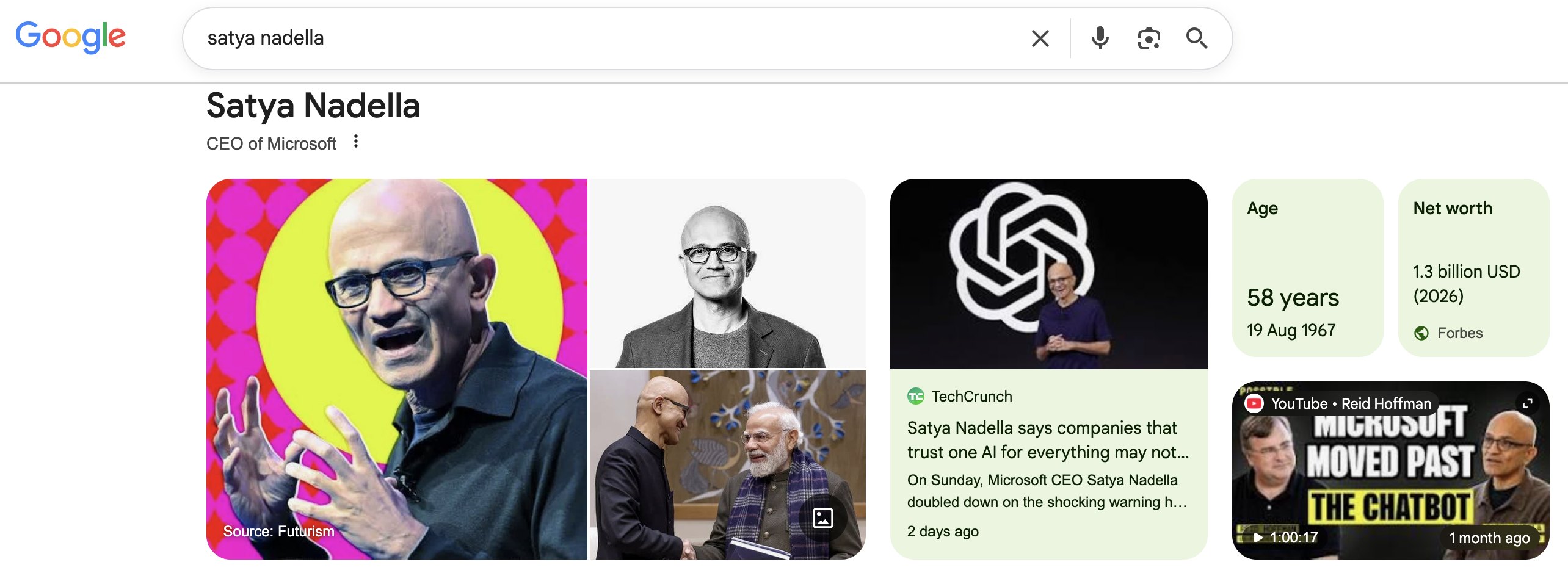
Swipe the result above to see all of it →
Same name. Two very different first impressions.
Illustration only — a generic example of how a Knowledge Panel renders in Search, not a screenshot of a real result.
This is what Google actually publishes.
A real Knowledge Panel, straight from Search. Notice what it contains: a plain-language description of who the person is, sourced and credited, followed by structured facts Google treats as established — date and place of birth, education, and more.
None of that was written by a marketing team. Google assembled it because the entity was well enough evidenced across sources it already trusts. That is the outcome the work on this page is aimed at.
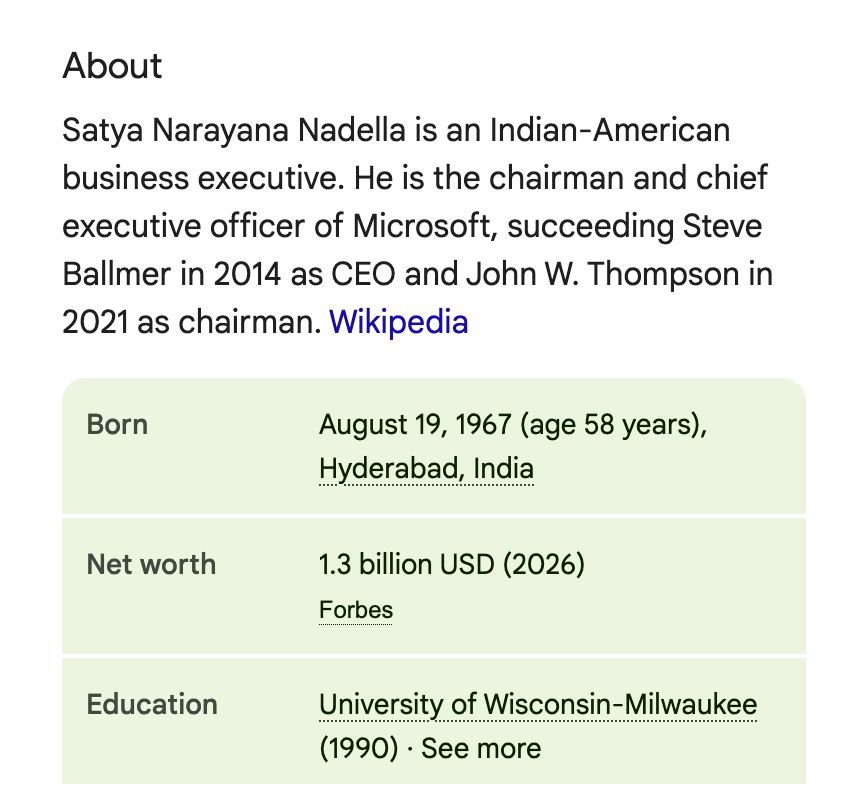
Screenshot of Google Search results for a well-known public figure, cropped to the panel's information section. Shown as an example of the format only — this person is not a client of The Spire Media, and we make no claim to have influenced this result. Google and the Google logo are trademarks of Google LLC.
What a Google Knowledge Panel does for you.
Trust
Google ties one clear identity to your name instead of scattering it across unrelated profiles and namesakes.
Visibility
The card sits where people check you first — above the fold, before they read a single link.
Control
Once claimed, you can request corrections when a role, title or fact goes out of date.
Authority
Structured facts drawn from credible sources read like a real operator, not a pile of blue links.
People who get searched before they get decided on.
Founders and executives raising or hiring. Investors and advisors doing deals. Authors, speakers and creators being booked. Consultants and specialists being vetted. Anyone whose name gets typed into Google before a meeting, an investment, or a signature.
It also matters for organisations: a company, product or publication can hold an entity in the Knowledge Graph just as a person can. We work with founders, executives and brands across the UAE, India and beyond — entity signals are global, so the work travels wherever you operate.
Four stages, from audit to claimed card.
Audit
We map how Google reads you today — what ranks for your name, which profiles conflict, which facts are missing, and what is blocking an entity from forming.
Align
Name, role, biography, organisation and links are made consistent everywhere they appear, so one coherent entity emerges instead of several partial ones.
Evidence
We build the corroboration Google looks for: structured data on your own properties, and genuine coverage and references from sources it already trusts.
Claim & maintain
When the card appears we walk you through verification, then monitor it — correcting errors and refreshing facts as your role changes.
Deliverables, not vague "brand work".
Entity audit document
Everything currently ranking for your name, every conflicting or stale profile, and a prioritised list of what to fix first.
Canonical fact sheet
One agreed version of your name, title, organisation, biography and links — the reference every profile and publication gets aligned to.
Schema implementation
Person and Organization structured data on your own site so Google can cross-check your facts against a source you control.
Profile alignment
Your website, social profiles, company pages and directory listings edited to tell one consistent story.
Evidence plan
Where credible third-party references can realistically be earned in your field, and the order to pursue them.
Claim support & monitoring
Help through Google's verification flow, then ongoing checks with correction requests when facts drift.
Nobody can guarantee a Knowledge Panel.
Google decides whether an entity is notable enough to show a card, and that decision is not for sale — not from us, not from Google, not from anyone reselling "guaranteed panels". What we can do is remove the reasons Google has for not showing one, and build the evidence it looks for.
Panels also take time, and some names are genuinely harder than others — a shared name with a public figure, or a field with little independent coverage, changes what is realistic. We will tell you honestly at audit stage if we think a panel is unlikely for you, before you spend anything on the build.
Start with the auditQuestions, answered.
What exactly is a Google Knowledge Panel?
It is the information box that appears beside or above search results for a recognised person, company or thing. Google assembles it from its Knowledge Graph — a database of entities and verified facts — rather than from any single web page. That is why you cannot simply write one yourself.
Can I pay Google to create one?
No. Panels are not an advertising product and cannot be purchased from Google at any price. Anyone claiming to sell you a panel directly, or guaranteeing one, is misrepresenting how it works.
How long does it take?
Alignment and schema work happens in the first few weeks. The card itself depends on Google recognising the entity, which typically takes months rather than days, and sometimes does not happen at all. We report on signal progress throughout so you can see movement before the card exists.
What does "claiming" mean?
Once a panel exists, Google can offer verification to the person or organisation it represents. Claiming does not let you rewrite the panel, but it does let you submit corrections and get them reviewed with priority.
My name is shared with someone famous. Is that hopeless?
Not hopeless, but harder and slower. Google has to distinguish two entities with the same label, which needs stronger and more distinct signals — your field, organisation and coverage all doing more work. We will say plainly at audit stage how difficult your case looks.
We already work with an SEO or PR agency. Does this overlap?
It complements them. SEO moves pages up rankings and PR earns coverage; entity work makes sure Google connects all of it to one identity. If you already have real coverage, that is an advantage — it is exactly the evidence a panel needs.
What does it cost?
The audit is scoped and quoted first, because the work needed varies enormously between a well-documented executive and someone starting from nothing. You get pricing in writing before any build work begins, in line with our Terms & Conditions.
Guides from our blog.
Find out what Google currently thinks you are.
Send us your name and links. We will come back with what is ranking, what is conflicting, and whether a panel looks realistic for you.